
Provider pair
AWS Route 53 + Azure DNS: one DNS zone on both
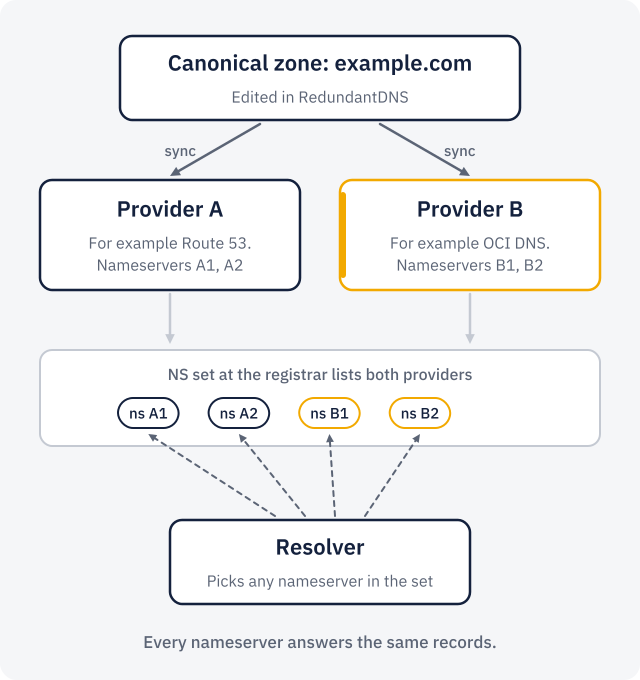
Run the same zone on Route 53 and Azure DNS at once. RedundantDNS writes every change to both, verifies them and probes their nameservers, and the NS set at your registrar lists both, so either one can answer.
How this pair behaves
- Route 53: the apex NS is rewritten to list the nameservers of every provider.
- Azure DNS: the apex NS is extended with the nameservers of every provider; Azure’s own nameservers always stay in the set.
- Records per record set are capped at 20 and TXT at 4,096 characters per record set, because Azure is attached.
- Features that only one provider has (for example Route 53 alias records and routing policies) are outside the canonical zone. The zone's capabilities are the intersection of both providers.
Set it up
- Connect AWS Route 53 with an IAM access key (permission guide).
- Connect Azure DNS with an app registration (service principal) with a client secret (permission guide).
- Create the zone in RedundantDNS, or adopt the one you already have on either provider.
- Attach both connections. RedundantDNS creates or adopts the zone on each and applies the records.
- Set the NS records at your registrar to the nameservers of both providers, as the dashboard lists them. The delegation check tells you when it is live.
Permissions, per access level
Pick the level per connection. The guides have the exact policies and roles to copy.
| Provider | Create and manage zones | Manage an existing zone |
|---|---|---|
| AWS Route 53 | Inline IAM policy with CreateHostedZone, DeleteHostedZone, ListHostedZones, GetHostedZone, GetChange, ListResourceRecordSets and ChangeResourceRecordSets. | Inline IAM policy scoped to one hosted zone ARN: GetHostedZone, ListResourceRecordSets, ChangeResourceRecordSets, plus GetChange on change ARNs. No ListHostedZones. |
| Azure DNS | Built-in role DNS Zone Contributor on the resource group. | DNS Zone Contributor scoped to the zone resource only (Azure supports per-zone role assignments). |
Good to know about each provider
AWS Route 53
- Alias records and routing policies (weighted, latency, geolocation) are Route 53-only; RedundantDNS leaves them alone and never touches the SOA.
- An optional CloudWatch statement lets RedundantDNS read query counts for managed-mode billing and usage charts.
Azure DNS
- Every zone attached to Azure takes Azure’s limits: at most 20 records per record set and 4,096 characters of TXT per record set.
- Alias record sets that point at Azure resources are left alone.
What the providers charge
With your own accounts you pay the providers directly and RedundantDNS charges only its plan. In managed mode these costs are passed through at cost plus 20%, line by line. Public list prices, collected on 2026-09-23; check the providers’ pages before relying on them.
| Provider | Per zone | Queries |
|---|---|---|
| AWS Route 53 | $0.50 per zone per month (first 25), then $0.10 | $0.40 per million (first billion), then $0.20 |
| Azure DNS | $0.50 per zone per month | $0.40 per million |
Related pairs
Put your zone on Route 53 and Azure DNS
Start with a 30-day trial: one zone on two providers you already have, no card. Plans from $9 a month after that.