
Provider pair
Google Cloud DNS + Cloudflare DNS: one DNS zone on both
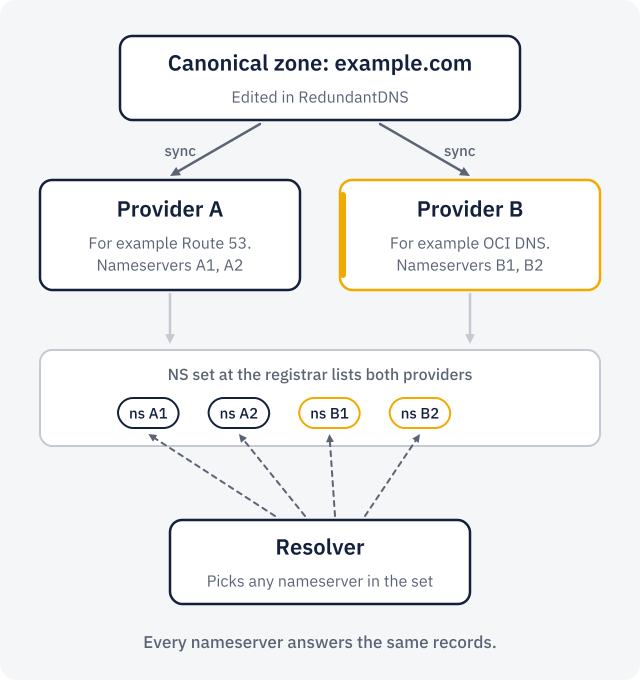
Run the same zone on Cloud DNS and Cloudflare at once. RedundantDNS writes every change to both, verifies them and probes their nameservers, and the NS set at your registrar lists both, so either one can answer.
How this pair behaves
- Cloud DNS: the apex NS is rewritten to list the nameservers of every provider.
- Cloudflare: the apex NS is rewritten to list the nameservers of every provider, with Cloudflare’s Multi-provider DNS setting on (RedundantDNS turns it on when it attaches the zone).
- Both Cloud DNS and Cloudflare serve the full nameserver plan at the apex: RedundantDNS turns on Cloudflare’s Multi-provider DNS setting when it attaches the zone.
- This needs a registrar where you can edit the NS set. A domain registered at Cloudflare Registrar stays on Cloudflare’s nameservers only; see the note below.
- The zone accepts TTLs from 60 seconds to one day, the range Cloudflare supports.
- With the "manage an existing zone" level on Cloud DNS, the key can edit every zone in its project: use a dedicated project for isolation.
- Features that only one provider has (for example provider-specific routing) are outside the canonical zone. The zone's capabilities are the intersection of both providers.
Registered at Cloudflare Registrar?
Cloudflare Registrar only allows Cloudflare’s nameservers, so the apex of a domain registered there cannot be on Cloud DNS too. Subdomains such as api. can, with no transfer, and the apex can once the
registration moves to another registrar.
Set it up
- Connect Google Cloud DNS with the JSON key of a service account (permission guide).
- Connect Cloudflare DNS with an API token (permission guide).
- Create the zone in RedundantDNS, or adopt the one you already have on either provider.
- Attach both connections. RedundantDNS creates or adopts the zone on each and applies the records.
- Set the NS records at your registrar to the nameservers of both providers, as the dashboard lists them. The delegation check tells you when it is live.
Permissions, per access level
Pick the level per connection. The guides have the exact policies and roles to copy.
| Provider | Create and manage zones | Manage an existing zone |
|---|---|---|
| Google Cloud DNS | Predefined role DNS Administrator (roles/dns.admin) on the project. | A custom role with the managedZones get/list, changes and resourceRecordSets permissions. It cannot create or delete zones. |
| Cloudflare DNS | Custom API token with Zone · Zone Edit and Zone · DNS Edit on one account. | Custom API token with Zone · Zone Read and Zone · DNS Edit on one specific zone. |
Good to know about each provider
Google Cloud DNS
- Cloud DNS has no per-zone permissions: the "existing zone" level can edit every zone in the project. Keep a zone that must be isolated in a dedicated project.
- Changes replace whole record sets atomically; large updates are split into changes of at most 1,000 additions and 1,000 deletions. Record sets with a routing policy are left alone.
Cloudflare DNS
- RedundantDNS turns on Cloudflare’s Multi-provider DNS setting when it attaches a zone. With it on, Cloudflare honors the NS records at the apex and activates the zone even though the registrar also lists other providers’ nameservers.
- Domains registered at Cloudflare Registrar can only use Cloudflare’s nameservers, so their apex cannot be multi-provider while they are registered there. Subdomains can. Cloudflare Registrar guide
- Records are always written with the proxy off (DNS only), so every provider answers the same addresses. TTLs must be between 60 seconds and one day.
What the providers charge
With your own accounts you pay the providers directly and RedundantDNS charges only its plan. In managed mode these costs are passed through at cost plus 20%, line by line. Public list prices, collected on 2026-09-23; check the providers’ pages before relying on them.
| Provider | Per zone | Queries |
|---|---|---|
| Google Cloud DNS | $0.20 per zone per month (first 25), then $0.10 | $0.40 per million (first billion), then $0.20 |
| Cloudflare DNS | free on the Free plan (DNS) | free |
Related pairs
Put your zone on Cloud DNS and Cloudflare
Start with a 30-day trial: one zone on two providers you already have, no card. Plans from $9 a month after that.